Banking On Grass: How Prairie Conservation Supports Ranchers and Wildlife
Post by Clemson student Ansley Callahan

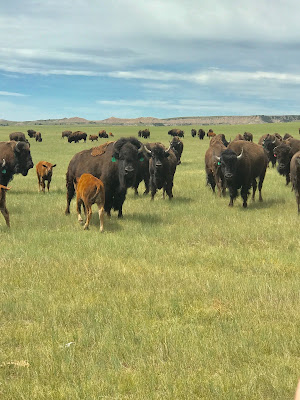
Traveling through Montana, I have found myself struck by the vastness of the prairie. The rolling hills and grasslands seemed endless on either side of the road we trekked, and it was easy to imagine the once-present massive herds of bison. Watching out of the window, I began thinking about how the prairie has changed over time and what it takes to sustain it today. While the land may look natural, it is shaped by countless management decisions that influence everything from plant communities to wildlife habitats.
Our visit to The Nature Conservancy's Matador Ranch offered a chance to see how conservation and agriculture can work together to sustain this landscape. The Nature Conservancy's mission is not merely to preserve land by excluding people, but to find ways for people and nature to flourish together. This ideology was evident throughout our visit and challenged some of my previous assumptions about what conservation looks like in practice.
We heard from Chisholm Christensen, a rancher, Grassbank member, and candidate for the Montana House of Representatives, who explained the purpose of the Matador Ranch and its Grassbank program. An idea that stood out to me was that conservation is not simply about protecting land from people. Instead, it can involve working directly with the people who depend on the land for their livelihoods. The Grassbank program allows ranchers to graze their cattle herds on Conservancy land in exchange for implementing conservation practices on their own ranches, such as protecting sage-grouse leks and prairie dogs. Listening to this explanation from Chisholm helped me understand that sustainability is often about finding common ground between environmental and economic goals.
What I found most interesting was the benefits of having a Grassbank like the one on Matador Ranch. Drought relief is a safety net for ranchers because they can move their cattle herds to the Conservancy land in dry years to allow their private land to recover. This reduces pressure on overgrazed pastures and helps maintain healthy forage for future seasons. From a ranching perspective, this flexibility can make the difference between maintaining a herd and having to sell cattle during difficult years.
Growing up around cattle in South Carolina, I found it fascinating to compare practices in Montana to what I have seen back home. In South Carolina, a common stocking rate is one cow per 2 acres of pasture. In Montana, however, ranchers often need around thirty acres to support a single cow. At first, that contrast seemed unbelievable, but after understanding more about the region's climate and grasslands, it made perfect sense. Montana receives far less rainfall than South Carolina, and the native prairie produces less forage per acre than the improved pastures common in the Southeast. This comparison helped me understand that sustainability looks different in different environments. What works in South Carolina with my polled Herefords would not necessarily work in Montana. Ranchers must carefully manage much larger areas of land to support their cattle while protecting the prairie's health. Witnessing this firsthand gave me a greater appreciation for both the challenges Montana ranchers face and the significance of programs like the Grassbank that help them stay resilient during drought and other environmental challenges.

The Grassbank also highlights the important relationship between cattle and prairie health. Before this visit, I had not given much thought to how grazing could actually benefit grasslands when managed properly. We learned that carefully managed cattle grazing can mimic some of the ecological effects once created by roaming bison herds. Grazing encourages new plant growth, recycles nutrients, and helps maintain diverse plant communities. Rather than viewing cattle as separate from the ecosystem, the ranch managers discussed how livestock can be used as a tool to support sustainable land management.
Grassbanks also help prevent land conversion by providing an economic alternative to plowing native sod. Native prairie is one of the most endangered ecosystems in North America, and once it is converted to cropland, many of its ecological benefits are lost. By helping ranchers remain economically viable, programs like the Grassbank encourage landowners to keep these grasslands intact. The ranchers need productive forage for their cattle, while competing interests, the Grassbank attempts to support both.
Another conservation perspective we learned about during our travels came from the American Prairie Wild Sky program. While The Nature Conservancy focuses heavily on partnerships with ranchers through programs like the Grassbank, American Prairie has a broader vision of reconnecting and conserving large areas of the Northern Great Plains ecosystem. The Wild Sky program pays local cattle ranchers to implement wildlife-friendly land management techniques. By supplying financial incentives, the program aims to offset the economic challenges of sharing the range with large carnivores and returning wildlife. Ranchers host secluded trail cameras on their property and acquire direct financial payouts for catching specific wildlife species. More considerable monetary rewards are provided for the presence of sensitive or apex predators, such as wolves and grizzly bears, thereby increasing local tolerance for these animals. Learning about both organizations showed me that sustainability can be approached in various ways. Although their methods may differ, both organizations share the objective of protecting prairie landscapes for future generations.
As I reflected on everything we learned during our visit, I was reminded of the Alabama song Pass It On Down. The song emphasizes the responsibility of each generation to care for the land and leave it in good condition for those who come after. Throughout the course, sustainability has often been discussed in terms of ecological, economic, and social systems. Nevertheless, the song's message prompted me to think more deeply about sustainability. The ranchers, conservationists, and scientists we met are all working toward the same goal: ensuring the future generations inherit healthy grasslands, productive ranches, and functioning ecosystems. Whether it is via The Nature Conservancy's Grassbank program or American Prairie's Wild Sky initiative, these efforts are ultimately about passing the prairie on to future generations in better condition than we found it. Listening to the stories of the people managing this landscape made the song's message feel real, as I could see firsthand what it takes to be a steward of the land rather than simply a user.
Leaving Matador Ranch, I came away with a greater appreciation for the role cattle play in sustaining Montana's grasslands. Sustainability is not about choosing between conservation and agriculture. Instead, it is about finding ways for both to coexist. Through programs like the Grassbank and Wild Sky, I saw how ranchers, conservation organizations, and scientists are working together to ensure that Montana's prairie remains productive, resilient and healthy for generations to come.