Different Scales, One Goal: Sustainable Beef Production
Post by Clemson student Ansley Callahan

One of the most eye-opening experiences during my time in Montana was visiting Yellowstone Cattle Feeders, a cattle feedlot that can hold up to 20,000 head at a time. Before this visit, I had never seen an operation of this scale, and it completely changed my understanding of what it takes to produce beef for a growing population. Watching thousands of cattle being managed so efficiently made me realize that sustainability is not just about protecting natural resources- it is also about producing enough food while using those resources responsibly.
The manager explained that the cattle are fed three times a day with carefully proportioned rations developed to maximize growth while retaining the animals' soundness. Most of the cattle gain between four and five pounds per day, allowing them to achieve market weight efficiently. He also shared that crossbreeds such as Angus and Wagyu tend to gain weight more easily than many other breeds, making them a favored choice because they reach harvest weight more quickly. I had never entertained how genetics plays such an essential role in agricultural sustainability. Choosing cattle with desirable traits helps producers to use feed more efficiently, produce high-quality beef, and lessen the time and resources required to raise each animal.
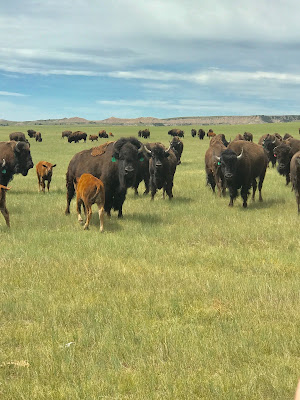
Another experience that widened my understanding of livestock production was visiting Milton Ranch, a large-scale cow-calf operation. Unlike Yellowstone Cattle Feeders, which bring cattle in for the finishing stage of production, Milton Ranch concentrates on raising healthy calves that will ultimately move into the next stage of the beef industry. Witnessing such a large cow-calf operation emphasized that sustainability starts long before cattle ever enter a feedlot. Proper grazing management, maintaining healthy rangelands, selecting quality genetics, and caring for breeding cows all contribute to producing calves after a year. It revealed to me that sustainable beef production begins with the responsible management of the ranch itself.

Visiting both Milton Ranch and Yellowstone Cattle Feeders also made me think about my family's operation back home, McConnell Polled Herefords. Our farm is much smaller, with only about 35 head, and it operates as a cow-calf operation. We raise calves that are either sold through the stockyard or retained to strengthen our herd. We also typically keep one steer every two years for our own family. That steer stays on pasture with the rest of the herd for most of its life and is only placed on a higher-energy feed ration shortly before it is processed. Although our farm is much smaller than Milton Ranch, the basic principles are the same. We still focus on maintaining healthy cattle, productive pastures, and quality genetics while making decisions that keep the farm productive for future generations. Comparing these three operations helped me realize that the size of an operation does not determine sustainability but how well resources are managed.
One of the biggest questions I found myself thinking about was whether a feedlot of Yellowstone Cattle Feeders' size could truly be sustainable. At first glance, 20,000 cattle in one location seems excessive, but I began to understand why these operations exist. With the world's population continuing to grow, demand for beef is increasing. Feedlots provide an efficient way to finish cattle while using carefully measured feed rations and closely monitoring animal health. By feeding cattle three times a day and achieving weight gains of 4 to 5 pounds per day, the animals reach market weight more quickly than they would on forage alone. Reaching harvest weight sooner means fewer total days requiring feed, water, veterinary care, and labor. At the same time, feedlots must carefully manage manure, water quality, air quality, and animal welfare to reduce their environmental impact. Sustainability does not mean agriculture has no impact- it means continually improving practices to produce food as efficiently and responsibly as possible while protecting resources for the future.
This venture also highlighted how interconnected the beef industry is. Large cow-calf ranches like Milton Ranch, smaller family operations like McConnell Polled Herefords, and finishing processes like Yellowstone Cattle Feeders all play separate but equally significant roles. Each relies on the others, and each contributes to producing beef consumers. The stakeholders include ranchers, feedlot managers, veterinarians, animal nutritionists, meat processors, consumers, and scientists, all of whom influence the industry's sustainability.
One of the most significant lessons I took away from these stops was that successful livestock production counts on informed decision-making. Whether handling 20,000 cattle at Yellowstone Cattle Feeders, a large cow-calf operation like Milton Ranch, or even the 35 cows on my family's farm, every decision has long-term developments for both the operation and the land. Producers depend on research and technology to select efficient feed rations, choose genetics that improve performance, observe herd health, and control grazing to keep pastures productive. These techniques help reduce waste, enhance animal welfare, and enable producers to continue raising cattle without exhausting the natural resources they depend on. Seeing how data and experience guide management decisions made me acknowledge that sustainability is not achieved by change; it demands continual evaluation, adaptation, and a willingness to improve production practices as new knowledge becomes available.
Before this experience, I mostly associated sustainability with conservation and protecting wildlife habitats. Visiting Milton Ranch and Yellowstone Cattle Feeders, while comparing them to my own family's farm, extended my outlook by showing me that sustainability also represents producing enough food to feed a growing population while protecting the natural resources on which agriculture depends. Although these operations differ greatly in size, they all rely on thoughtful management, scientific innovation, and long-term planning. This experience revealed to me that the size of an operation does not portray sustainable livestock production; rather, it is the devotion to balancing animal care, environmental stewardship, and economic viability so that future generations can continue producing high-quality beef. Whether it is a family farm with 35 head, a large cow-calf ranch, or a 20,000-cattle feedlot, each operation plays an essential role in creating a sustainable beef industry.